The correct ITALIAN pronunciation of ricotta is ree-KOHTT-ah
Want to wow your guests and family with a fresh ricotta that takes about 15 minutes of prep time? You control the texture of the ricotta by your straining technique, and can have it thick or silky depending on what you wish to use it for.
So, if not Italian, you might not know all the uses of ricotta. Just a name few:
- Top your pasta with a few tablespoons as you would put grated cheese on top.
- Serve as an appetizer with honey and walnuts or fig jam or just about anything flavorful; black oil-cured olives work well
- Add a few tablespoons to a slice of pizza or a whole pie [you can add before cooking or after or to some leftover store bought pizza to make it special]
- Layer in a lasagna
INGREDIENTS
- 1 quart of whole milk [either the milk or cream should not be ultra pasteurized; you can usually find a pasteurized type of milk but I find it difficult to find the cream that way; having both just pasteurized is ideal]
- 1 pint of heavy cream
- 2 teaspoons of kosher salt
- 3 tablespoons of white vinegar
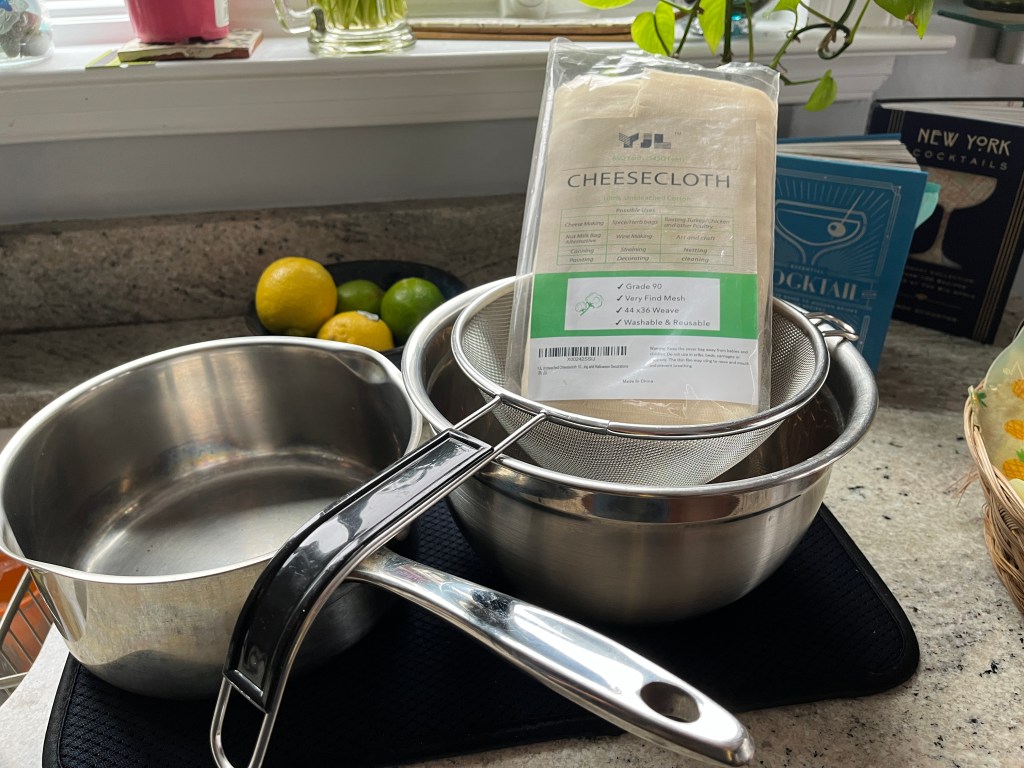
EQUIPMENT
- Cheesecloth
- Metal small-holed strainer that can fit your liquids when cooked
- Bowl large enough that strainer can sit on with enough room for whey [the liquid remaining after milk has been curdled and strained to drain]
PREPARATION
- Pour quart of whole milk and pint of heavy cream into a sauce pan [larger sauce pan better]
- Add 2 teaspoons of kosher salt, mix well
- Heat until milk foams and boils; you need to stir constantly and watch like a hawk since once milk starts to boil, it is quick and when it goes over makes the biggest mess ever on your stove
- When milk boils, remove from heat and add 3 tablespoons of white vinegar
- Stir until you start to see the milk curdle [about 1 minute or so] If you do not see curds forming you can add another tablespoon of vinegar
- Pour slowly into your metal small-holed strainer that you’ve lined with cheesecloth
- Let ricotta drain through cheesecloth so whey lands into the bowl below
- Remove the ricotta when the texture is to your liking. The longer it drains the thicker ricotta becomes so for lasagna you would want it thick for other uses you might want it less solid and creamier.
NOTES
I have failed at this process because of the ultra pasteurization of the milk products. I have learned that a little more vinegar sometimes can overcome a fail. A fail would be defined by milk not producing curds.
Whey can be used for many things: I fed my outdoor potted plants with it one summer. Downside: the possum would come and dig up the dirt to get at the whey. Search uses of whey–there are many.
You can also make ricotta from the whey produced after making mozzarella–this for another time.
 Fun and Other Serious Matters