Ablated

As I start this story, it is May 14, 2024, six days after my ablation. I never believed this story would have to be written in 4 parts, but so be it, you will have all the information now and I hope it might be useful for your health and state of mind. And, as usual, hopefully a little funny.

I left off in The Heart Stories Part 3 after being discharged from the hospital after experiencing two cardioversions. They did not fix me but gave me hope that the next procedure would work. After all you must always have hope.

An ablation uses heat or cold energy to create tiny scars in the heart. The scars block faulty heart signals and restore a typical heartbeat, thus bringing you into a normal sinus rhythm.

Part 3 detailed the rise in my atrial fibrilation from 2% to 93% after my TAVR procedure. I understood that sometimes that happens. What I didn’t realize is that you cannot function with 93% afib, or at least I could not. After the cardio versions they started me on a medication called amiodarone. It is a powerful drug and my doctor mentioned that googling it might not be a good idea. I was infused with this drug slowly before leaving the hospital over a 24 hour period and now I would be taking two 400 mg per day dose. At this point my ablation was scheduled for May 8th, the day after my 76th birthday–and I was looking forward to it.

As each day passed after the cardio versions, I got weaker, dizzier and basically unable to do anything worthwhile. My heart was in a constant flutter. Depression set in quickly and I withdrew from everything. I think this is important because I think the depression and anxiety was worse than my heart fluttering. I don’t think I ever experienced such a feeling and hope to never again feel that way.

Aside: I usually put my stories through an Artificial Intelligence filter to check any discrepancies and it provides feedback about the story. The AI feedback from Part 3 was the ending should be more positive. I will take that feedback as a gift.

Between April 24 and May 8th was difficult. There were some things that I was determined to do. For one, my friend who passed in January was going to be celebrated at a gathering on a Sunday at the restaurant at the Public Theatre. What was odd was I was also scheduled to go to a show at the same theatre on Tuesday of that week. I fought my anxiety to go to the celebration of my friend’s life, but Mike was driving and I could escape at any time if necessary. The gathering included some of my colleagues and friends who I haven’t seen in years and they were all there for my dear friend singing praises of her life–which was indeed too short and quite unexpected at the time. During this period of time, I would get manic and talk louder than usual and a lot. I already talk a lot, so this was very obvious to me. It was good to be with people I loved that could excuse this behavior.

That was Sunday and now I was deliberating about whether I would go to that theatre again for a show called Generation Women on Tuesday night. I have been to a few other similar shows and it was 6 women covering 6 decades telling a specific story. The story they were asked to provide was the “worst decision they ever made.” A good friend called me and said she would pick me up at my house and drive to Manhattan and then drive me home and then continue on to her house in New Jersey. I thanked her and said I would call her on Monday and let her know. I started to feel anxious about going and called and declined her kind offer. On Tuesday, I decided I needed to push myself, so another call to my friend that I changed my mind. She drove to me, I drove to the city and back to my house. Having a good friend supporting me was a blessing and I will never forget her kindness. I am actually unsure how I did this, but I do know that you can fight anxiety with the help of others. It was a good night with 6 friends having dinner and seeing a great show with stories both happy, sad, funny and serious. I solemnly thought if this was my last night, I would leave this earth a happy camper.

I cannot explain how much love I received from friends during this time. By putting my stories out there, I received prayers, love, support, compassionate from oh so many people. I will be forever grateful for them.

The rest of the week and weekend passed slowly and tediously, but I was definitely ready for this procedure and putting this all behind me. My birthday was here–I didn’t even have a cocktail–for sure I will make up for that. I received the call from the hospital which said show up at 9:30 am on May 8. I knew that meant my procedure would happen a few hours after that. For some strange reason, or from all the prayers and thoughts I was getting, when I got to the hospital I was no longer anxious. I was in their hands and today it would be over.

I was told that the TAVR is so much more intrusive than the ablation. TAVR goes through arteries; ablations goes through veins. OK, no kneeling on my groin to stop the bleeding–that definitely was a plus. It was also under general anesthesia which is not great, but I would rather be asleep than awake.

On arrival, I was greeted by RN Nicole who said she would be my caregiver until I was taken in. Nicole and I realized we lived in the same neighborhood. She had twin boys, about 1 year old and a daughter about 6. We talked about schooling and churches. Staten Island is a small place. She was in the same parish as me [the new parish that I fled to in December]. She asked why I left my original parish since it was closer to my house and I explained that the pastor drove me out by a crazy-ass sermon. She actually grew up on the block where his mom lived and had heard some not-so-kind comments about him recently. This was not surprising to me, but I was not going to sit around badmouthing a priest before this procedure. I do say a Hail Mary for this guy each morning….I pray that he would “be better.” [That will be the last time in my life that I use a phrase from Melania Trump, but it seemed too perfect not to.]

I met Jason and two or three other caregivers–everyone was friendly. My bed was positioned right in front of the door where another person was receiving an ablation. So this patient went in sometime before 9:00 am and it was now 12:30 pm and he was still in there. It is not a sterile room, which surprised me but there was so much equipment and people walked in and our a few times. My sister had an ablation not too long ago and said she was astounded by the amount of people and technical equipment in a small room. The room I could peek into on occasion was also small, with monitors, computers and people. It was also darkened. I always thought of operating rooms being very bright–this was the opposite.

Aside: At a point while I was waiting, a crew of administrators and hospital personnel came into this room to talk about a rebuild that was going to happen. They were in there a long time talking about moving equipment, number of beds, etc. I found it amusing at first, but quickly tired of the noise and people.

Finally, the patient was wheeled out of the room. From my perspective he looked OK and was groggy but awake. There was another patient in this room; a woman who only spoke Russian. I was pleasantly surprised that they had a special TV screen that they rolled around to patients who needed a translator. I could hear the man on the monitor translating everything the doctor was saying to the patient. It was almost like a zoom call. I had never seen that before and really never thought about it. Good to learn new things.

My doctor and the anesthesiologist were the same as the previous patient. He greeted me and apologized for the delay. I urged him to go take a break, have lunch and be fully refreshed for my procedure. I really wasn’t kidding–I was dead serious. I signed papers for the anesthesiologist and would eventually sign some releases from my doctor. He said he would get some lunch and be back as soon as he could. I nonchalantly told him to take his time. At this point I was already there 4 hours and could wait a bit more.

Everyone returned at about 1:30 pm and the lead nurse from the ablation room came to speak with me. Her name was Joy–I instantly liked her. She was professional, kind and compassionate–you really can’t ask for more than that. She explained that they would be putting many patches on me. My first thought was I was still trying to get the sticky tape off me from the cardioversions and now Joy was explaining there would be many many stickies on me. The internet defines these stickies as “The grounding pad–adhered to the patient’s skin away from the surgical site—is intended to safely return the electrical current from the patient back to the generator through a cord or cable.” Simply put, the sticky pads are grounding mechanisms to keep you from being electrocuted during the procedure. OK, now. I already know more than I need to know.

Joy allowed me to walk into the room, it was only about 100 feet from where my bed was. The bed in this room was tiny and looked totally uncomfortable. But alas, there were pillows that inflated around your body and it was not that uncomfortable. I hopped on the table and Joy started explaining each and every ground pad. I wondered how long this would take, because by now I was starving, wanting to be asleep and having this procedure over. Joy introduced me to the team of about 9 people. They included RNs, doctors, tech people plus me. I always like to look mobile when in a hospital. I believe it is important for those treating you to know, you walked, you talked and you wanted to leave in better shape then when you arrived.

Once I laid down, they put a few more electrodes on my legs, feet, arms, just about everywhere there was skin. Then the mask and the direction to breathe deeply.

5 hours later–I felt a tube being pulled from my throat–not painful–just realization that I was awake and the procedure was over. I didn’t know what time it was but it was the first question I asked. It was 7:30 pm. Wow! That took a long time! My doctor told me he called Mike and that everything went fine. I knew from previous conversations, this procedure would not relieve me immediately. The scarring of the heart had to form. I felt I was in sinus rhythm and that was a good thing. I now had to stay on my back for about 4 hours. No problem, I was actually tired and very groggy–general anesthesia does that to you.

In about an hour, they wheeled me into a room on the cardiac unit. For some reason I got a suite with a 20 foot window looking over the Verazzano Bridge and the water. Lovely! There would be no food tonight and I was ok with that. A nutritionist came by and took my breakfast order. I was not interested in being on my phone, or listening to a podcast, or doing anything but sleeping.

I woke up for sunrise which was beautiful. I moved around a bit and felt OK, there was no part of me in extreme pain. Whoa! This is good. Now to get up and get to the bathroom which was huge with a modern walk-in shower. The nurse came in before I attempted to get out of bed. I had no IV hooked up so it would be simple to disconnect from the monitor and walk to bathroom. I cannot remember this nurse’s name but she was lovely and kind. She said she would bring me some towels and I was grateful to be able to wash up. Nurse said the Physician Assistant for the Cardiac Electrophysiology would be in to see me and I would probably get released today. She was explicit that it takes time–and I was OK with that.

I received a really delicious breakfast; I guess this suite room received really good and hot meals. I was hungry but as expected could not finish because I hadn’t eaten in a while. I had also forgotten my tea bags, which I usually keep in my bag just for this hospital visits. I do not like Lipton.

I was released just after noon and actually walked out by myself. Other than having a load of black and blues on both arms, I was OK. Mike was right in front and we drove home. This was May 9th.

At home, I was tired, watched some TV and went up to bed at 7:00 pm. Scrambled or hard-boiled eggs would be my diet for at least 4 days. I didn’t have an appetite but knew I needed the protein. What happened next both surprised and depressed me. In the morning, I felt awful. Every part of my body hurt; my skin to the touch as if I had shingles. I was dizzy, nausea and weak. OK, this is day 2, I shouldn’t expect that much. I did nothing but sit in a chair, go to bed and nap, then sit in a chair again. Thinking about leaving the house was terrifying. This is not me….this is someone else recovering. I bounce back. I took some tylenol and went to bed again. So Friday and Saturday passed and I was miserable. On Saturday I walked a block; heart rate went up immediately but no afib.

I decided I would need to be patient; I had heard people recover quickly from ablations but mine was long and tedious and general anesthesia stays with you for a few days. Cocktails were not a part of life for this time and I kinda missed my gin martini.

As of today, May 17th, I am not fully recovered. The side effects of the drug I am taking are powerful. Luckily the dose has been reduced to 200 mg per day as opposed to the 800 mg I was taking for the 2 week period before the ablation. I have been told that this drug builds up in the system and remains there for a while, so I have reasoned that it is this drug making me dizzy, nauseous and weak. I have not since April 22 taken a walk longer than a few blocks. Walking now brings my heart rate up immediately and makes me uncomfortable. I went out and planted a few seeds….very slowly and deliberately. I know that my depression is caused by lack of exercise. I force myself to do something each day–I am not talking strenuous by any stretch of the imagination. So for now, no yoga, swimming, walking or Y classes. I time how much I sit and make sure that I get up and walk around the house and up and down the stairs and in the backyard. I definitely do not want to feel like this forever.

I know that the ablation takes a while to correct your heart into a sinus rhythm and I am hoping it is sooner than later. I am supported by such loving friends and family. I receive so many messages and calls each day. One day I felt so great, I sent out individual messages to many that I had a great day. I hope I can do that more often. I want to tell everyone that I am fine–but I know I am not fine every day. It will come.

Every once in a while I wonder if I did not do the TAVR procedure, what would be. It was my decision on the advise of my doctor. It was unusual that someone with severe stenosis of the aortic artery had no symptoms–I was never tired or out of breath. I was living a fine active life and I certainly hope to do that again soon.

Fixing this and breaking that

Today is April 22, 2024 and I am in the Staten Island University Hospital Emergency Room. I have been here since yesterday. This story below was written before today and was meant to update you to some challenges with the TAVR procedure. But yesterday I believed I was having a heart attack and so Mike delivered me to the Emergency room.

But let’s go back a few weeks to about two weeks after the Fitful Heart story.

So as I recover from my recent TAVR procedure, I have not gotten back to feeling like my “old self.” So what did my old self feel like: a lot better than the new self.

I went into the TAVR procedure knowing it would take care of my aortic stenosis. The new bovine valve would make blood flow through my heart more freely–it gave it more elasticity to go through. I also knew that it would have no effect on my Afib–or so I thought. The Afib has always been the annoying factor of this two-tiered heart problem. I never had any symptoms of stenosis. As I mentioned in the previous stories, I had been asked numerous times whether I was out of breathe while exercising or when I did stairs. I never had any symptoms of the stenosis. I always felt good while exercising. Swimming, walking or cardio has never been a challenge. I am most comfortable when in that mode.

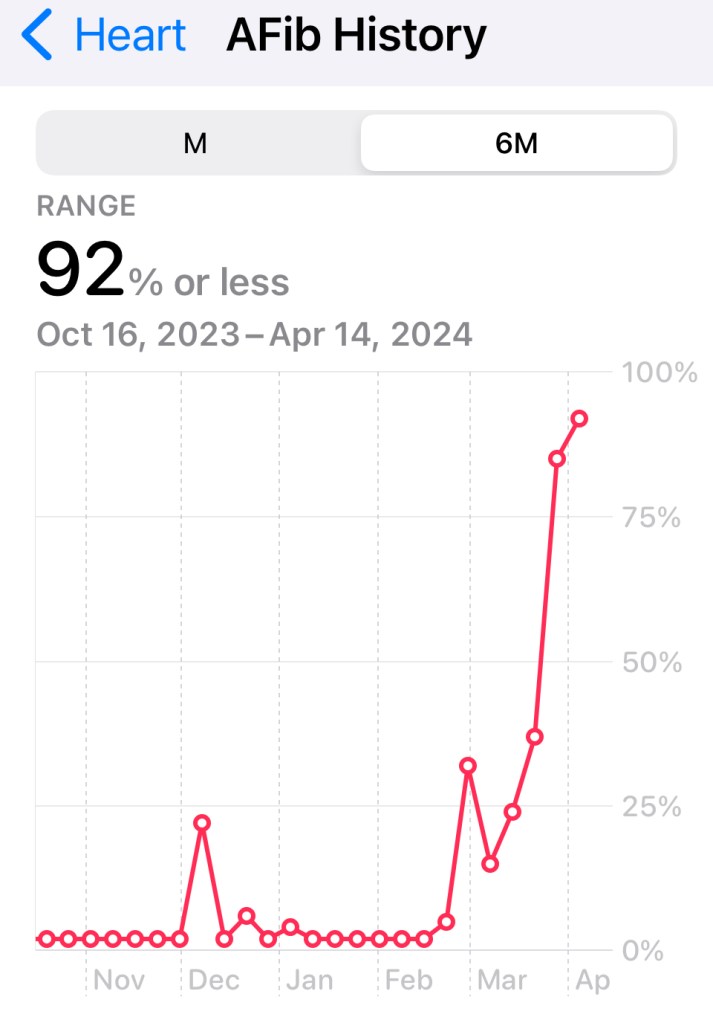
Now, all of that has changed. My new self has a hard time exercising, resting or sleeping. The Afib has taken over my new self. My afib was usually 2% or less and I hated it at that rate. I felt it every time it happened. Once I got an Apple Watch I was able to track it better and affirm that when I felt it coming–it was coming. My heart rate fluctuates between 45 and 135 on an average. It can be 45 once minute and 135 the next and then down to 70 and then up again to 90. The variation feels disconcerting.

Since the TAVR procedure on February 21 my Afib has gotten worse each week. The numbers now indicate I am in Afib over 90% of the time. It is exhausting. So as my blood flows more freely through my new heart valve, my Afib feels free to exert itself more vehemently. I have no other way to think of this.

The one difference is that since the valve allows more blood through, I feel the Afib less. The variation is there for sure, but what I feel is different.

It definitely is exhausting but it feels different. This is difficult to explain and as I write I try to force my body to explain it to my brain. When the Afib was at 2%, as it came on, I shivered with the anticipation. Usually it subsided in 20 minutes or an hour, but from experience I understood it would go away. Being a little nerdy, I actually wrote down every time I felt the afib and then after a month I calculated whether my Apple watch caught everything I was feeling. It was affirmation and sometimes you need affirmation. When in afib I would get up and walk around or do some deep breathing or just distract myself from what I was feeling. Now it is always there and as the time has passed since the TAVR my Afib gets worst and I feel awful. I now feel lightheaded and at times dizzy.

Exercising or walking is a challenge. I run out of breathe. I swam 2 or 3 times but couldn’t make the mile….just got tired. Now it is impossible to do any of these things. My life has dramatically changed from being active to sitting around doing very little. [You might have thought I had more time to finish up this story, but there is an aspect of depression that dwells with me.]

After the TAVR I was on a heart monitor for a month. After that time, they schedule an appointment with an electrocardiologist and they share the results. I knew what the results would be since I am aware of being in Afib. The monitor showed the same as my Apple watch–I was experiencing this phenomenon 40% of the time. This has always been weird to me—the further I got away from the TAVR the more the Afib persisted and grew. The electrocardiologist mentioned that sometimes after a procedure such as TAVR, the workings of the tubes through your arteries disturbs the electrical current of your heart. Right now I am sounding like I know a whole lot about this. Believe me I would rather not have this and so not know this. So this was a possibility and now the offer of the other doctor to do open heart surgery instead of a TAVR and fix both the stenosis and the afib makes more sense. I still believe I would have said no to the open heart surgery. It is really invasive.

So the next step is to schedule an ablation. This procedure would have an 85% chance of keeping the afib at bay. This is the definition of ablation: a medical procedure that removes or destroys a body part, tissue, or its function. It can be performed using drugs, hormones, radiofrequency, heat, surgery, or other methods. 

At first read, my brain went to “removes or destroys a body part, tissue, or its function.” That is terrifying. Was it going to kill the function of my heart? But, luckily, I had an ablation before….my eye doctor ablated the gel tissue around my eye, so I knew it could not be referring to eliminating the function of my heart, but just destroying the tissue that is causing the electrical interference to the beat of my heart.

Now my brain moves to the question of exactly what love is held in that soon to be ablated heart tissue. After all, look at all the music created about your heart and love. I have given my intellect permission to move away from the poetic and think only medically. Yes, my intellect and emotion are interconnected and provide me some great outlooks into life and love.

So I have scheduled the ablation for May 8, the day after my 76th birthday. I need this to be fixed; it is disrupting my life. All pre-op and other appointments have been made. I have been told it is simpler than the TAVR, less invasive, no artery entrance so no need to kneel on my groin to stop the bleeding. I was very relieved to hear that.

APRIL 22

Well as I mentioned, the lightheadedness, dizziness and exhaustion led me to the emergency room yesterday. I was supposed to be cooking pot roast but when I could not breathe and my blood pressure was 153 over 117 I caved to the idea of going to the emergency room. I think that everyone hesitates before going to the ER–might be that you question your symptoms or you think what you are feeling will pass–but I never think anyone does it lightly. I don’t believe I ever gasped for air before and I hope I never will again. I have a new appreciation for those with asthma or panic attacks.

Two of my cardiologists were in the hospital yesterday–on a Sunday–who knew they work on Sundays without an emergency. One of the doctors was my TAVR surgeon. He said that my main cardiologist mentioned I might be mad at him–after all before TAVR I felt whole and well. Now I don’t. I am absolutely not mad at him. He fixed my stenosis; my blood flows well through my heart and I have no blockages. Maybe I would have liked to know that the afib might get worse but I can’t find any stats that confirm that is common or expected.

So today, in a little while, my cardiologist will perform a cardioversion. It is a medical procedure that uses quick, low-energy shocks to restore a regular heart rhythm. I write this but don’t dwell on it. As I spoke with both doctors, there was agreement that I was suffering more from Atrial Flutter than Atrial Fibrillation. They are similar and when I was originally diagnosed I was told I experienced both. But when I think about the afib feeling different before and after the TAVR, this might explain it. I am now feeling flutter. The difference for me is that the feeling is almost constant–your heart doesn’t keep a sinus rhythm and just flutters–it is exhausting.

A funny aside: as I am sitting here writing this, one of the ER resident doctors comes by and as they always do, ask a few questions. His question “have I ever been diagnosed with sleep apnea. I say “no”; he asks whether I snore, I say “no.” He then indicates that my hemoglobin was a little high and that might indicate sleep apnea which might cause afib or flutter. I mention this as a “funny aside” because I will do absolutely nothing with this information. The doc is probably accurate with his statements, but I definitely don’t think it has to do with me. After all, I have a shitload of data that indicates my flutter and afib got out of control after the TAVR procedure. I will file his information for a later date.

So I am currently listening to MSNBC provide the jury instructions given in the Trump trial. After all this is actually a historic day: a former president goes on trial for a number of felonies . . . and I will have a cardioversion. I guess it is more memorable than the day of the TAVR: International Sticky Bun Day.

APRIL 23

Julienne and Suzanne were the caregivers and technicians for the cardioversion. Suzanne had just come back from Rome and had booked through Costco online and said it worked really well. Julienne was headed to Napa for her birthday. We spoke a bit about good wineries to visit and whether a stopover in Sausalito might be fun. As we were waiting for the procedure to begin I had told them about the lateness of my TAVR because of the anesthesiologist from Brooklyn getting stuck in traffic. Not 2 minutes later, who shows up but the guy from Brooklyn. We all laughed, though the Brooklyn anesthesiologist thought it was a little bit creepy that I remembered he was late.

What is not fun: Cardioversions. Think about all those TV shows when they shock someone back to life. That’s what it is like. The humane information: you are totally unconscious of what is going on. The procedure takes maybe 15 minutes or so. They put pads on your chest and back for protection. Then they put a camera down your throat to check for blood clots around your heart; if none are found they then shock your heart. When they remove the anesthetic drip, you are immediately awake. As I opened my eyes and said hello to all the caregivers, they gave me the bad news: it did not work. I had read and knew that this procedure was, I’ll call it, “iffy.” But the possibility of this working enticed me to try it and my cardiologist thought it might work. The next decision was for a slow drip of a medication that might help get my heart back to sinus rhythm.

The rest of the day was uneventful. I watched the monitors, saw my heart go in and out of sinus rhythm and then back into flutter. I hoped I could get home and keep my appointment for the cardiologist that would do the ablation. That did not happen and as of now, I am in a cardiac unit, still getting a slow drip of this medication.

A cardiac doc came by this morning; he mentioned the possibility of doing another cardioversion this afternoon. I told him that was not going to happen. It looked like he understood. Was it the tubes, or black and blue arms, the pain in my chest from the first zap or just the look of horror on my face. I am currently waiting for more information.

An aside: nutritionist came in and asked what I wanted for breakfast. When I mentioned orange juice she said I couldn’t have it because of my diabetes. I informed her that I was not a diabetic. She insisted I was and that it was listed in the tablet. When the nurse indicated I definitely was not diabetic, the nutritionist told me she had no way to override the tablet from calculating that the juice would bring me over my sugar intake for the meal. So watch out the technology will cure you or keep you from getting your juice.

I have just been notified that I will be discharged shortly–not fixed, just discharged. I’m OK with that. I now can look forward to the ablation and getting better. Fingers crossed.

More to come … telling the story is keeping me sane.

MACARONI PIE

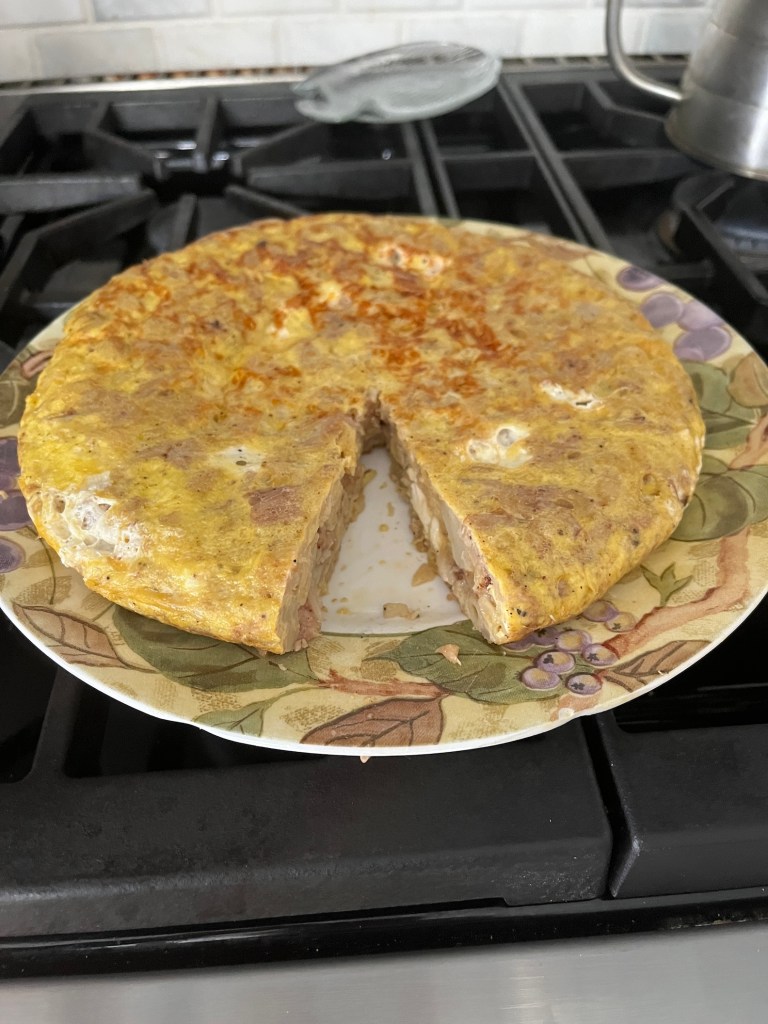
GREAT RECIPE FOR LEFTOVER PASTA

Macaroni Pie is the perfect recipe when you have leftover pasta. It doesn’t matter whether the pasta was served with sauce, butter, veggies or meat—it is all going in the pie. I list the bare minimum in spices but feel free to use any you like based on the type of sauce your pasta was originally served with. I might be heavier on the basil if my pasta has red sauce and possibly coriander for pasta with chicken. Rigatoni or large square pasta will not work as well as something smaller like elbows, spaghetti, wagon wheels, ziti or any smaller variety.

INGREDIENTS

  • 1/4 lb Leftover pasta [use whatever you have] 
  • 5 eggs at room temperature 
  • salt & pepper
  • garlic & onion powder
  • 1/4 cup shredded mozzarella or other cheese that melts well
  • 2 oz parmesan cheese

VARIATIONS:

You can add diced leftover meat as well as any cooked vegetables chopped and mixed into the pasta. My original pasta for this recipe was made with cauliflower sautéed in butter and one thinly sliced left-over breaded pork chop.

DIRECTIONS:

  • Set leftover pasta aside to reach to room temperature
  • Mix the eggs well with all ingredients but pasta
  • Heat non-stick pan and drizzle with a little oil
  • Keep pan on medium heat.
  • When pan is very hot add the pasta and work with a wooden spoon to make it the shape of the pot.
  • Then use the spoon to move the pasta away from the sides of the pan. Do this for a minute and then pour the egg mixture on top. The mixture will settle in between the pieces of pasta. Cook on a medium heat moving the pie a bit so it doesn’t stick. At about 20 minutes, when the pie is almost cooked through put a plate on top of the pan and turn over. Then return to the pan so that opposite side will brown. The second side will cook more quickly probably 10 minutes. Pie should be lightly browned on both sides. 

After trying this recipe come back and leave comments for other ingredients or changes you experimented with.

Universal Language of ALZHEIMERS*

UPDATE ON KEEPING HIM SAFE AND HAPPY

When writing about my sister and the care of her husband [KEEPING HIM SAFE AND HAPPY] I mentioned that the New Year’s Eve Mexico cruise was the last she would embark. The reasons were logical….she could not care for her partner on a cruise ship. There simply was not enough room.

On the trip before Mexico, we had sailed out of New York City to Nova Scotia. It was September 2022. The cruise was for 7 days with stops each day in Rhode Island, Maine and then Prince Edward Island and Halifax. I vividly remember two events on that trip: the death of Queen Elisabeth while we were in Canada and misplacing my brother in law. I fail to call it out as “we lost him”, I would describe it as “he moved without telling us”. There were 6 of us on this trip and we immediately walked back to the chair he sat and moved out from there in a circle on a search. In less than 10 minutes, he was found on a chair out of the sun and inside the main port of call station–needless to say we were relieved. To keep my sister calm I kept telling her not to worry we were in Canada and they would, for sure, take good care of him.

I mention all of this because of an encounter I had this afternoon at the YMCA. It made me remember Ben getting lost and the kindness and love bestowed on him when he was found.

I went to the Y for a swim and as I took off my jeans I heard two women speaking. I did not understand the language, but believe it was Russian. The Y hosts many diverse seniors and I find that the Russian and Chinese immigrants are swimmers. The cadence of one of the women was repetitive–she was saying the same words over and over–gently and patiently. I do not know what words they were but the other woman responded with a sigh and a audible OK. Upon visual observation I noticed that one of the women was opening and closing the locker without taking anything in or out. She also took off her shirt and then put it back on. She was definitely confused.

Then it dawned on me, the language I heard was the chant of the caregiver. Chant is defined as “repetitive vocalization used in spiritual practice to strengthen community, heal illness, and overcome psychological and emotional difficulties. In many traditions, chanting is used to induce mystical states, an altered state of consciousness characterized by a profound sense of peace.”** This was a caretaker and a woman with dementia. The language is universal. The chants persist in the answering of the same question, the reassurance of the same answer–over and over again. This in turn brings a sense of peace to the afflicted.

I happened to finish swimming at the same time and was in the sauna with both women. I observed the same behavior and decided I would ask the chanter a question. I didn’t want to seem nosy but definitely wanted this woman to understand that I saw and felt her love for her companion. And just maybe, she would have an opportunity at an adult conversation where chanting was not required. I introduced myself first, since I felt awkward about doing this, but Tamara gave me her name and simply said “this is my older sister Lucy.” I boldly asked whether she had dementia and was told yes. Before she could say anything else, I told her I could feel and see the love of her care. She said sometimes it was hard and that Lucy’s husband had lost it as well. I could see that Lucy wanted to join the conversation and she repeated that her name was Lucy. I told her it was nice to meet her.

I spent some time conversing with Tamara about caring for someone you love. She mentioned the enormous challenge to everyone but that the love was the constant–the love that Lucy’s children and other family members could give her. Tamara’s greatest fear was that Lucy would get argumentative and aggressive. She spoke about having a new doctor’s appointment to see whether there was any medication available. I just listened because I thought that is what was needed. As I left the sauna, Tamara said she hoped she would see me again and I felt better about being intrusive and asking questions.

As I was getting dressed, both Tamara and Lucy came out of the sauna. They sat on a bench in front of the lockers and it seemed that Lucy was upset. I began to hear the chant and I observed Tamara gently massaging large circles on Lucy’s back in consolation of whatever was bothering or terrorizing her. Soon Lucy quieted down and was comforted. Tamara looked calm but relieved. This was pure love in caretaking.

There was no doubt in my mind that Lucy was in good hands and was kept happy safe by those who love her.

The language of caregivers for those afflicted with memory loss is a chant: a universal chant that connects caregivers all over the world. They are special people.

Photo mine: Galleria Nazionale d’Arte Moderna e Contemporanea⁩, ⁨Rome⁩, ⁨Centro⁩, ⁨Italy⁩

*Alzheimers is used interchangeably with dementia throughout this story. They are not the same condition but they manifest the same.

**Perry G, Polito V, Thompson WF. Rhythmic Chanting and Mystical States across Traditions. Brain Sci. 2021 Jan 13;11(1):101. doi: 10.3390/brainsci11010101. PMID: 33451163; PMCID: PMC7828722.

Keeping Him Safe and Happy

Everyone deals with partners with Alzheimers differently. No matter what you do or what decisions you make, they are the ones that are best for you and your partner.

Everyone who knows me knows that I love my sister deeply. Recently, I attempt to go to Florida about every six weeks to visit her which is a sure sign that I love my sister—because Florida is not my comfort zone. This particular trip was special: it was a celebration of my brother-in-law’s 80th birthday.

My sister’s husband was diagnosed with Alzheimers a couple of years ago. There were definite signs before the diagnosis, but my sister would not talk about it. She clearly was having a moment of denial and I can certainly understand the dynamics of that emotion. If I deny, it is not really happening—we have all been there. Although she understood that everyone knew what the situation was, she was not willing to speak about it. I felt sad I could not commiserate with her and that she had no one to speak with about it. It took me a while to figure out that, firstly, she did not want to embarrass him in any way and admitting that he was losing his ability to function was over the top for her. And secondly, she did not want anyone to feel sorry for her. 

They say it is impossible to diagnose Alzheimers before you die but there are reliable neuro clinics who run batteries of tests on people to see whether there is something else happening that could be cured. 

One day I was out shopping and got a call from my sister. I could hear she was upset. She then clearly said to me: Ben has Alzheimers and then she cried. It would be a few months before she could put this diagnosis in perspective. Her first thoughts and actions were if I talk to him all day long and explain when he doesn’t understand something, I can keep him lucid. I can remind him of what he forgets. I could nudge him to remember things long forgotten. I could explain everything happening during a TV program. Basically, my sister believed she could stop his decline if she could do more. 

She still was traveling up to Pennsylvania to visit her son’s family, and was going on cruises, and the 4 hour drive to visit her granddaughters in Orlando. I actually went on three cruises with her during this time. As much as I loved being with her on these adventures, I understood at one point, that it was an absolute nightmare for her to travel. Every moment traveling with a person with Alzheimers means every thought you have and every action you take is for two people. You are totally responsible for another adult. 

On our last family cruise to Mexico for New Year’s Eve 2023, she told me on day two of the cruise, that she would never travel again. I have begun to understand why and respect her decision. She always made it look easy. 

When I spent time with her, I am amazed at her patience and perseverance. My sister was a caregiver—firstly in a pediatric ward of a large NY hospital, then in a local nursing home and then she became one of the first certified oncology nurses. She cared for those who were dying and nursed those who would survive. 

Every once in a while I give her advice and then I kick myself for even mentioning it. How could I possibly understand what she is going through and what was best. I am as clueless as everyone else who is not caring for someone with Alzheimers. 

She can speak freely now and laughs at some funny things that occur. Sometimes you laugh so you don’t cry. She has put routines in place so that she can take a walk in the morning and he can be safe in the house. She has him take a walk to the corner a few times a week, as well as ride a three-wheeled bike. He comes back quickly—sometimes she wonders if he actually left the garage. She does an exercise video every day with him; although I hear him tell her sometimes “why are we doing this?” She has put the hot tub in their routine as well as a dunk in the pool, followed by a shower and shampoo. She will bring him to the supermarket and other stores, but Costco is a stretch—he at times forgets how to walk—the one foot in front of the other—and the spatial disruption of the disease. When she does Wordle or Waffle, she involves him in the solving. He is good at finding the word but cannot figure out the “green/yellow boxes.” She explains them each day. 

Her day is filled with his care and directions on what comes next; and of course endless questions. He has lost the ability to know what to do—from getting out of the bed to sitting at the table for breakfast. He needs even the simplest directions. I think it is  profound that this happens to those suffering from Alzheimers. Each case is different and the care differs. 

Her life, as well as his, has changed drastically but she describes her mission as “keeping him safe and happy—that’s all I can do”. She does a marvelous job. I love her dearly.

Mariupol

How would we know such evil existed
should we have known such evil existed?

I heard them shout
we must help Ukraine;
I heard them debate
how can we help Ukraine;
I heard them whisper
there is no way to help Ukraine.

20,000 dead in Mariupol

Are we allowed to grieve
how can we mourn; we did not dwell with them 

20,000 dead in Mariupol

I had to pay some pennies more
each time I filled up the tank, but

20,000 dead in Mariupol

We arm; we sent aid
we raise our voices in outrage to such a tragedy, but still

20,000 dead in Mariupol

We send rockets; we fly drones
ammunition is abundant, but yet

20,000 dead in Mariupol

They hid in a steel plant with no light of day
Babies and children with moms
Abandoned by dads in war and so

20,000 dead in Mariupol

The night they left home

They turned and looked at their home as they closed the door. I can hear the swish and the double-click of the lock.

Best they lock the door that would not be opened again—maybe never—or at least never by this family.

Footsteps are light on the walkway to the main street. Of course, it is silent at 2 am and they are light on their feet. 

They have backpacks—even the 4 year old is sporting a new backpack. There is a cartoon character—possibly Spider Man–adorning its zippered pocket. He looks like a little man following his papa and in front of his mama with light footsteps walking between them.

He is excited to be out after midnight but wary of the silence of the night. He was told the family would make a long journey and he imagined it would be an adventure. He has new sneakers with a double knot his mama insisted on tying. She did not want him to be able to take them off. 

He would wear them for miles—many many miles.

THE DEPARTURE

I awoke one morning to the shadows reflected on the wall from my curtains . . . and then I remembered Ukraine. 

They had curtains in their home . . .

Might have been a gingham check of red and white hung on a window looking out at toys in the yard. Satiny curtains in the living room kept it shady for the tomes on the bookshelves. A mahogany china closet held the glassware and china passed down from a grandmother. Adorning the mantel were the photos, so many photos, of all those they loved and revered. 

They had curtains in their home . . .

A cool breeze made the curtains blow in while they were eating breakfast, making sandwiches for the children’s lunchboxes, and peeling the carrots for the evening stew.

They had curtains in their home . . .

There were dresses hanging in the closet waiting to be passed on to the younger children—some handmade—others bought from the catalog.

They had curtains in their home . . .

Those red and white gingham check curtains are torn and charred now and frame a window with shattered glass. The toys in the yard are under the stones that fell from the roof when the bombs came. There are no dinners now—grandma’s china is broken in a million pieces that were once the thread that held their family together. The photos, although blackened by fire still remain to document those who had to leave without looking back.

They have no curtains . . . they have no home.

[Published at https://www.smerconish.com/exclusive-content/the-departure/ ]